If you use a dynamic microphone, you have probably come across the term Cloudlifter. It is one of the most commonly recommended accessories for streaming and podcasting setups, and it appears alongside a lot of popular broadcast dynamic microphones. But not everyone needs one, and whether it helps or not comes down entirely to one thing: how much gain your interface can supply.
What a Cloudlifter is
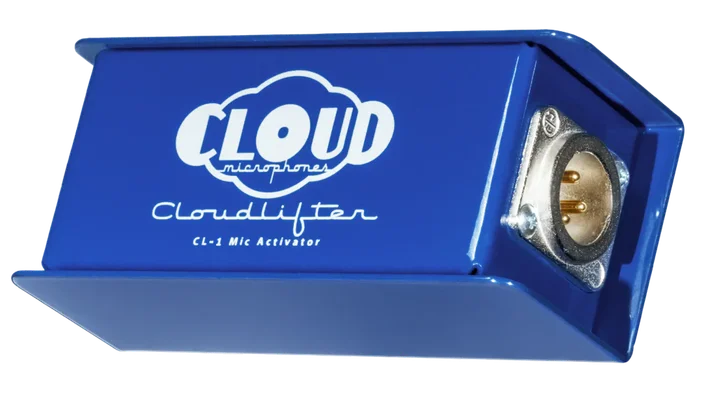
A Cloudlifter is a microphone booster placed between a low-output dynamic or ribbon microphone and your audio interface or mixer. It adds roughly 20 to 25 dB of clean, transparent gain before the signal reaches your main preamp.
It is powered by the phantom power supplied by your interface, so no additional cable or external power source is needed. It does not pass phantom power through to the microphone itself, which keeps passive ribbon mics safe. You connect it via standard XLR cables, and it works immediately with no settings or software required.
Why dynamic microphones need more gain
Not all microphones output the same signal level. Condenser microphones use phantom power to drive their powered capsule and internal electronics, and as a result, they deliver a stronger output signal compared to dynamic microphones. Dynamic microphones are passive, meaning they rely entirely on your preamp to bring the signal up to a usable level.
When a preamp is pushed toward its maximum gain range, it can introduce noise and degrade the signal. By boosting the signal cleanly before it reaches the main preamp, a Cloudlifter lets the interface run at a lower, more comfortable gain setting and can meaningfully improve the practical noise floor of an underpowered setup.
When a Cloudlifter actually makes sense
A Cloudlifter is most useful when your interface cannot supply enough clean gain for your microphone. Many entry-level and mid-range interfaces were not designed with demanding dynamic microphones in mind, and cranking the preamp close to its ceiling is where noise problems start. It tends to help most in these situations:
- Your interface has limited gain headroom and struggles to get a usable signal from a dynamic mic without introducing noise
- You are using older equipment where the preamp itself becomes the bottleneck
- Your interface has a high noise floor that gets worse the harder you push it
If your interface already has a low noise floor and plenty of headroom, a Cloudlifter is unlikely to improve anything.
When you do not need one
If your interface already delivers plenty of clean gain with a low noise floor, a Cloudlifter adds no meaningful benefit. You already have the headroom needed to drive any dynamic microphone cleanly. Adding one in front of a capable preamp also introduces a few downsides:
- An extra active component with its own self-noise
- An additional cable and connection point in the signal chain
- A fixed input impedance of around 3 kΩ, which can subtly shift how the microphone responds depending on the model
When the preamp already has the gain and noise performance to handle a dynamic microphone cleanly, a Cloudlifter is unnecessary
No Cloudlifter Required for Elgato Wave devices
All Wave XLR interfaces are built with enough gain to drive any dynamic microphone cleanly without a boost in front of them. Wave XLR and XLR Dock deliver 75 dB of gain, while Wave XLR MK.2, XLR Dock MK.2, and Wave XLR Pro step that up to 80 dB.
That gain is applied digitally, keeping the analog input stage clean and avoiding noise caused by pushing analog circuitry too hard. It is the same problem that a Cloudlifter exists to solve on underpowered interfaces, handled directly on the hardware itself.
If you are using any of these devices, you do not need a Cloudlifter. The preamp handles it cleanly on its own, and adding one would only introduce extra components without any meaningful improvement to your signal.
The short version
A Cloudlifter is most useful when your interface cannot supply enough clean gain for your microphone. Many entry-level and mid-range interfaces were not designed with demanding dynamic microphones in mind, and cranking the preamp close to its ceiling to get a usable signal is where noise problems start.
PRODUCTS IN ARTICLE